IT Staff Augmentation in DFW
Hiring takes months. Projects don't wait. Whether you're backfilling a departed sysadmin, scaling up for a network overhaul, or simply covering a leave of absence, Adaptive IP Services places experienced IT professionals directly into your team, on your timeline, at your pace, without the overhead of a permanent headcount.

What we do
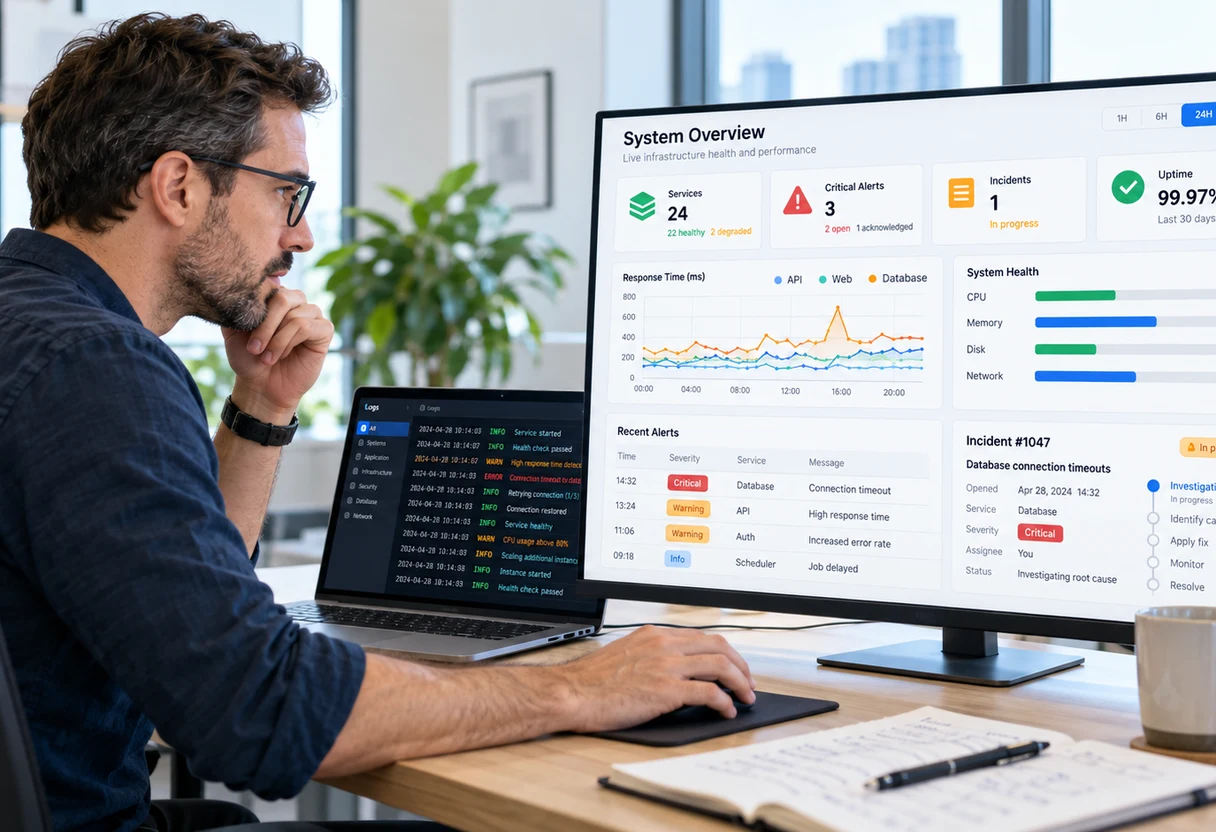
We embed skilled IT professionals into your existing team as if they were staff, following your processes, working in your tools, and accountable to your priorities. This is not a managed service arrangement where we take over a function; it's augmentation, meaning your team stays in charge and we fill the specific gap.
Placements range from a single specialist for a defined project to multiple engineers covering a sustained operational need. The engagement can be short-term (weeks), medium-term (a quarter or two), or ongoing with no forced long-term commitment. When the need changes, the engagement scales to match.
We cover both on-site work in the DFW metro and fully remote placements for clients anywhere in the country. Local engagements can begin quickly, no cross-country logistics, no timezone friction.

What's included
Roles we place span the full range of enterprise IT operations:
- Network engineers, LAN/WAN design and implementation, routing and switching, firewall configuration, SD-WAN deployments, network segmentation, and ongoing troubleshooting
- Security analysts, vulnerability management, SIEM monitoring, incident response support, security policy enforcement, and compliance-oriented network review
- Systems administrators, Windows Server, Active Directory, Azure AD/Entra ID, virtualization platforms (VMware, Hyper-V), storage systems, and backup infrastructure
- Help desk and desktop support, Tier 1 through Tier 2 support, endpoint management, user onboarding, ticketing system operations, and escalation handling
- Project engineers, dedicated technical leads for defined initiatives: migrations, infrastructure refreshes, new-site buildouts, cloud onboarding, or technology consolidations
Beyond filling a seat, every placement includes:
- Needs assessment before placement, we talk through the role, the team context, the tools in use, and the specific gap so we match capability to what you actually need, beyond the job title on paper
- Onboarding coordination, we handle knowledge transfer from departing staff when that's the reason for the gap, documenting environment details and operational runbooks as part of the engagement
- Progress visibility, you get regular reporting on work completed, issues surfaced, and any risks identified during the engagement; no black-box arrangements
- Knowledge transfer on exit, before a placement ends, we structure a deliberate handoff so institutional knowledge stays with your team, not us
- Flexible delivery model, on-site in DFW, fully remote, or a hybrid split that fits your operational model; hours can be full-time equivalent or part-time depending on scope
Who it's for
Staff augmentation fits a specific set of business situations. If any of these describe where you are, it is worth a conversation.

You lost a key technical employee. A resignation, a termination, or a medical leave created a gap in an operational role. The work doesn't stop, but a permanent replacement is weeks or months away at best. A placed engineer can carry the load while you hire, or discover, once the pressure is off, that a permanent hire isn't necessary.

You have a project that exceeds your team's current bandwidth. A cloud migration, a firewall replacement, a new-office buildout, these are finite projects with defined endpoints. Hiring a permanent employee for a six-month project creates a retention problem the moment the project ends. A project engineer placed for the duration solves that without the downstream cost.

Your team has a skills gap on a specific technology. Your sysadmin is solid, but the new SD-WAN deployment requires skills your team hasn't built yet. Rather than sending existing staff through a lengthy certification track, you bring in someone who already has the experience, gets the work done, and transfers working knowledge to your permanent team along the way.

You're between IT vendors or staff models. Some businesses are transitioning away from a managed service provider, building an in-house team, or restructuring after an acquisition. During those transitions, operational gaps appear. Augmentation bridges those gaps without locking you into a new long-term arrangement before you know what model you want to land on.

You need senior-level expertise without a senior-level salary. Hiring a senior network security architect or a seasoned systems engineer as a full-time employee is expensive and competitive in the DFW market. A fractional or project-based placement gives you access to that experience level at a cost that matches the actual scope of the need.
You're a DFW business that has tried staffing agencies. General-purpose IT staffing agencies place bodies against job descriptions. We place experienced practitioners against operational problems. The difference shows up immediately in how quickly someone can be productive in your environment.
What you can expect
The process is direct. You contact us, describe the gap, and we assess fit within a matter of days, not weeks. If we can staff the role, we tell you specifically who we would place and why. If the need falls outside what we can cover competently, we say so rather than placing someone who isn't the right match.
Once a placement begins, the person embedded in your team works inside your environment: your ticketing system, your communication channels, your change management process. There is no parallel reporting structure or offshore handoff layer. The engineer on your team is the engineer doing the work.
Timelines are realistic. We don't promise a 24-hour placement on a role that requires genuine expertise. Network engineers and security analysts with meaningful operational experience take a few days to confirm and schedule. Help desk and systems administration placements can typically move faster.
Billing is straightforward and tied to actual hours or a defined project scope, no long-term contracts required for short placements, no surprise fees for knowledge transfer or documentation that should have been included from the start.
When an engagement ends, it ends cleanly. Runbooks are updated, credentials are rotated out, access is removed, and your team has what they need to continue operations independently. That outcome, your team stronger and better documented than before, is the standard we hold the engagement to.
For DFW businesses, our local presence matters. We understand the market, we can be on-site when on-site matters, and we're not coordinating across time zones to get someone in front of your infrastructure.
Frequently asked questions
How is staff augmentation different from a managed service?
With augmentation, your team stays in charge and we fill a specific gap. We embed a professional into your team, following your processes, working in your tools, accountable to your priorities. It is not a managed service where we take over a function.
What roles can you place?
Network engineers, security analysts, systems administrators (Windows Server, Active Directory, Azure AD/Entra ID, virtualization, storage, backup), help desk and desktop support (Tier 1 through Tier 2), and project engineers for migrations, refreshes, and new-site buildouts.
How fast can someone start?
We assess fit within days, not weeks. Help desk and systems administration placements can typically move quickly. Network engineers and security analysts with meaningful operational experience take a few days to confirm and schedule. We will not promise a 24-hour placement on a role that requires genuine expertise.
On-site in DFW or remote?
Both. We cover on-site work across the DFW metro and fully remote placements for clients anywhere in the country. Local engagements can begin quickly without cross-country logistics or timezone friction.
What happens when the engagement ends?
It ends cleanly. Runbooks are updated, credentials are rotated out, access is removed, and your team has what it needs to continue operations independently. Knowledge transfer on exit is part of the engagement, not an extra fee.

Need to fill a gap on your team?
Whether you are backfilling a departure, covering a leave, or scaling up for a project, we can place experienced IT professionals on your timeline.
Or email: info@adaptiveips.com